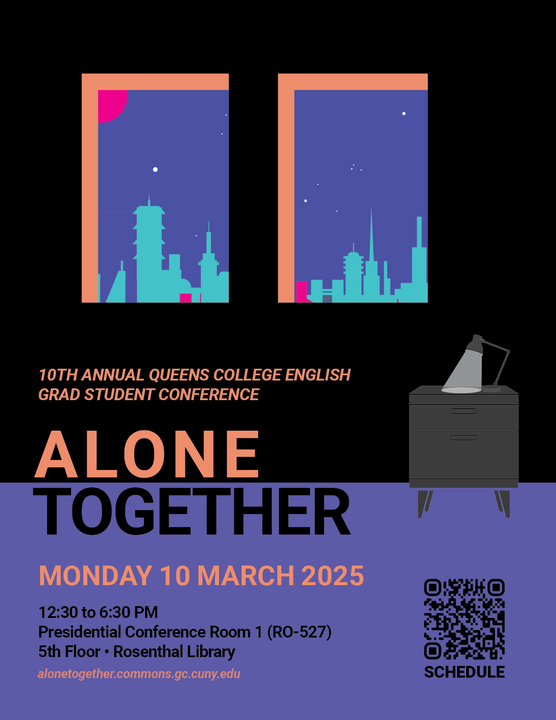
Hello All, I’m writing to remind you that the MA student conference, Alone Together, will take place next week on Monday, March 10, 2025, in the President’s Conference Room 1, on the fifth floor of Rosenthal Library from 1 pm to 6 pm. I’ve pasted the program and the conference poster below. (You can also find this information on the conference website<https://alonetogether.commons.gc.cuny.edu/>.) It would be great if you could attend a session or more to support your colleagues who are presenting work. All are welcome to the reception in Klapper that will precede Edwidge Danticat’s reading at 7 pm that day. I’m also sending along the Summer 2025 English MA course descriptions. Registration begins next week on March 12, although students could register early by emailing me on March 11. The descriptions are attached as a pdf and also pasted below, after the conference program. If you have any questions, feel free to contact me or Cliff. Best, Bill ALONE TOGETHER PROGRAM March 10, 2025 1:00 to 2:30 Alone in the City * E. Marvin Brown, “Financial Nihilism— An Action Research Project. Generation Z Grapples Alone Against the Great Inflation and The Bubble of Everything” * Raveena Nabi, “Helga Crane: Trauma in Isolation” * Elle Schwetz, “Tying Strings Together: Increasing Solidarity by Placing Lived Experiences in Dialogue” * Louise Linh Tran, “Chasing Connection, Finding Loneliness” 2:45 to 4:15 The Desire to Connect * Enid Brain, “‘Simply Seen Her’” Transfemme Isolation and Community in Nevada and Glamour Boutique” * Adriana Fischetti, “The Invisible Woman” * Kaitlynn Lee, “Longing and Belonging: Breaking Boundaries in Bishakh Som's Spellbound” * Nina Thomas, “Speculative Spheres: Racial and Sexual Identity in Bishakh Som’s Spellbound” 4:30 to 6:00 Interiors and Confinements * Kayla Baur, “Upstairs/ Downstairs” * Boguslaw Mitrega, “Yearning for a Path Not Often Taken: The Politics of Narrative Form in Anuk Arudpragasam’s A Passage North” * Jennifer Olson, “The Dream Life of Comics: Dreams, Rehabilitation, and Art in Asterios Polyp” * Gabrielle Sarrubbo, This Woman’s Work: Guðrun’s Vengeance and Place of Women in the Elder Edda” 6:15 to 6:45 Reception in Klapper Hall, 6th Floor 7:00 Edwidge Danticat Reading and Discussion LeFrak Hall [cid:image001.png@01DB8CD7.12EE5C70] SUMMER 2025 ENGLISH MA COURSE DESCRIPTIONS Session I (4-week session, June 2 to June 26) English 719. Medieval Epic Literature Online, Asynchronous Prof. Edward Currie Course Code: 6983 The epic is generally taken to be one of the oldest and most venerable genres, a literary form used by ancient cultures to represent their legendary origins and martial achievements. This course, a survey of medieval ‘epics’ (i.e., quasi-epics with epic features and pretensions) from the eighth century to the thirteenth, explores the diversity of forms and purposes that can be found in epic productions of the medieval period and the difficulty of bringing these extremely varied texts under one denominator. Although works within this genre have much in common, they are also diverse enough that it is hard to speak of them as belonging to one tradition. A heroic epic may include narrative elements—varying in number and type—derived from myth, legend, and folklore. The text may center on a single hero, or a group of warriors (e.g. a dynasty), exemplifying virtues we expect in literature of this sort, but also qualities particular to a certain culture and foreign to modern notions of ‘heroism.’ We will read texts composed in medieval England, France, Scandinavia, and Carolingian Germany; namely, Beowulf, The Song of Roland, The Saga of the Volsungs, and The Nibelungenlied. Some of our texts share the ‘same’ heroes and narrative situations, represented very differently according to the purposes of particular authors, the periods when they were composed, and the audiences for whom they were intended. The literature will be read in translation. Students will submit daily responses and write two papers: the first requires close readings of a text; the second is a research paper that involves engagement with scholarship. This online course will be asynchronous. Class discussions will occur on our Brightspace site, where required lectures and other course materials will also be available. English 781. American Women Playwrights MTWTh 6:45 to 8:25 pm, online synchronous Prof. Rhoda Sirlin Course Code: 6926 This special topics course will focus on American women playwrights, some of whom have won the Pulitzer Prize for Drama and some who are significant for other reasons. We will explore themes and approaches of these women dramatists and what their plays reveal about American culture. Among the topics considered are the relationship between women writers and their cultural and social backgrounds, conditions affecting women’s literary production, including their struggle for gender parity in the theatre world, the influence of female and male precursors, the impact of race and class, and the continuities and breaks with the dominant literary traditions; additionally, we will explore how contemporary theatre is connected to Greek tragedy and to Ibsen’s realistic social dramas of the 19th century. We will begin with the mother of American drama—Susan Glaspell, writing plays before women could vote—and end the course with the most recent winner of the Pulitzer Prize for Drama—Eboni Booth. Some of the other women playwrights we will discuss are Lillian Hellman, Lorraine Hansberry, Beth Henley, Marsha Norman, Paula Vogel, Rebecca Gilman, Sarah Ruhl, Quiara Alegria Hudes, Lynn Nottage, and Martyna Majok. Session II (7-week session in June 30-August 18) English 732. Latinx Childhood MW 6:00 to 8:05 pm, online synchronous Prof. William Orchard Course Code: 6927 In the heart-wrenching stories of migrant families torn asunder at the US-Mexico border, the Latinx child has emerged a key figure in contemporary political discourse. Although we are often inclined to think of childhood as a universal experience or a time of innocence, childhood is affected by a host of historical, economic, social, political, and cultural factors. In this class, we will examine the experience of Latinx childhood in three ways. First, we will consider the ways in which Latinx coming of age narratives have to rework the conventions of the bildungsroman in order to account for the roles that race, ethnicity, class, gender, and sexuality play in a Latinx child’s growing understanding of their social roles. Second, we will read recent works in young adult and children’s literature to examine how Latinx childhood is being represented to young readers. Finally, we will consider the various ways in which childhood has been invoked and deployed in contemporary debates in the United States about immigration. Likely text include Sandra Cisneros’s The House on Mango Street, Tomas Rivera’s And the Earth Did Not Devour Him, Justin Torres’s We the Animals, Javier Zamora’s Unaccompanied, and Valeria Luiselli’s Tell Me How It Ends, and the film Coco. English 781. 20th Century Poetry: Modernism to Postmodernism TTh 6:00 to 8:05 pm, online synchronous Prof. James Richie Course Code: 6925 While new work is continually being done to re-examine the claims, terms, and historical contexts for modern poetry, there’s a general critical consensus on what poetic modernism entails and what works may be considered modern. Postmodern poetry, which both emerges and diverges from the tenets of modernism, is another story. Parameters are starting to emerge, but for the most there’s still debate on what counts as postmodern or if there even is (or was) such a thing as a “postmodernism.” This course is going to examine modern and postmodern American poetry with a historicizing lens to understand how poets from the early part of the century developed poetic strategies to account for the feeling of overwhelming, rapid, and unprecedented historical change and how the poets of the mid part of the 20th century drew from and critiqued those strategies to account for their own historical moment. It will also conclude by analyzing a few poets whose work emerged much later in the 20th century (or beginning of the 21st) to think through how these writers may be dealing with their own inherited dual legacy.